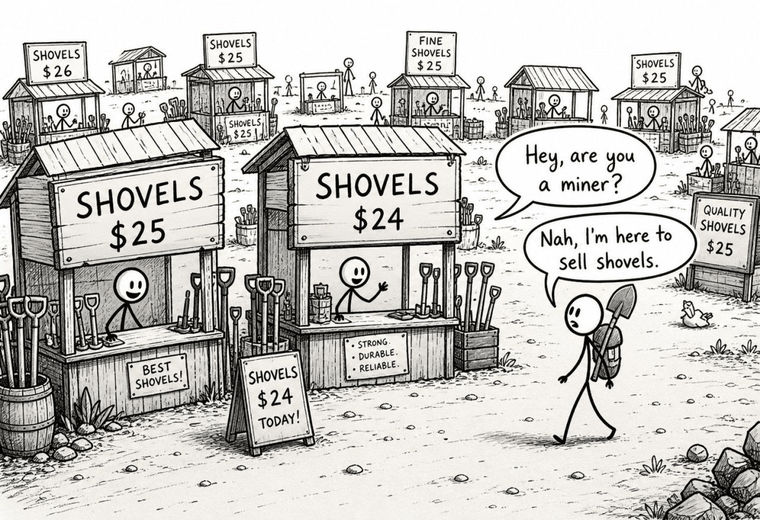
The joke comes from familiar startup advice: during a gold rush, it's better to sell shovels than to search for gold yourself.
It's a reasonable strategy until everyone starts following it.
Looking at parts of the technology industry today, I sometimes wonder whether we've ended up in a similar situation.
Tools for people who build tools
There seems to be software for almost every stage of building a software product.
Some tools help developers write code. Others automate testing, manage infrastructure, monitor performance, create AI agents, or track what those agents are doing.
Then there are tools for managing those tools.
We can automate the development of automation, analyze the performance of performance analytics, and build platforms that help other companies build platforms.
None of this is inherently bad.
Infrastructure, development tools, monitoring, and automation make many modern products possible. Companies working on these problems perform essential engineering work, even when their contributions are invisible to the eventual customer.
But somewhere in this expanding collection of capabilities, it's worth asking a simple question.
Who ultimately benefits?
Imagine a company building a platform for AI applications. Its customers create their own products. Those products require monitoring, analytics, security, and cost management, creating demand for more specialized tools.
Every company in the chain might have paying customers. Each might solve a legitimate problem for the next.
But the long-term health of the entire ecosystem still depends on whether somebody needs the applications at the end of that chain.
If that demand never materializes, building increasingly sophisticated infrastructure cannot manufacture it indefinitely.
This doesn't mean every infrastructure company needs to serve consumers directly. A database vendor doesn't have to explain its value to someone buying shoes online. Its immediate customers have real engineering requirements of their own.
The important point is that somewhere down the line, there must be work worth paying to accomplish.
A better shovel still needs a buyer
In the cartoon, every seller offers essentially the same product.
One advertises quality. Another has a larger inventory. A third cuts the price by a dollar.
These are reasonable competitive strategies if miners are actually lining up to buy shovels.
But a discount from $25 to $24 won't solve the problem if nobody nearby is mining anything.
Building SaaS can lead to a similar mistake.
We study existing products and identify their weaknesses. We decide to build a faster interface, add more integrations, lower the subscription price, or introduce a fashionable AI capability.
The result might be excellent software.
Yet these decisions primarily answer how to build a better tool. They don't establish whether enough people need that tool badly enough to change how they work and start paying for it.
Y Combinator has a famously short principle: "Make something people want".
Its advice to founders translates that principle into actual work: ship something, talk to users, observe what they need, and iterate based on feedback.
There is no requirement to invent an entirely new industry.
The challenge is finding a real need.
And customers rarely describe their needs as perfectly organized feature specifications. They describe their jobs, frustrations, constraints, mistakes, and repetitive tasks.
Understanding those situations can be considerably harder than adding another setting to an interface.
A good shovel doesn't need to be revolutionary
There is another problem with the way we talk about technology products.
Everything seems to need a revolutionary ambition.
A product must transform an industry, reinvent a workflow, or permanently change how people do their jobs.
But most people don't open business software because they want to participate in a technological revolution.
They have work to do.
An accountant needs accurate calculations. A developer needs to understand what's happening with an issue. An administrator needs to manage access without creating unnecessary security risks. A manager needs to identify problems before they become serious.
None of these jobs necessarily requires a new category of software.
Sometimes the most valuable improvement is making an existing process clearer, removing unnecessary steps, and ensuring the system behaves predictably.
A good shovel doesn't need to surprise its owner every morning.
It needs to be durable, comfortable, and reliable. If someone uses it every day, those qualities eventually matter far more than an unusual handle design.
Business software isn't so different.
Stability, sensible configuration, understandable permissions, data integrity, interoperability, and access to meaningful support don't always make compelling launch headlines.
But they help determine whether someone can rely on a product for years.
A small SaaS that handles a particular workflow exceptionally well doesn't need to apologize for being specialized.
And it certainly doesn't need to pretend that every improvement is a breakthrough.
Technology doesn't create a reason to use a product
AI makes this distinction particularly relevant.
It's increasingly easy to imagine a new use for a language model: generating text, analyzing documents, creating issues, preparing reports, or automating another step in a workflow.
Sometimes these capabilities eliminate substantial amounts of manual effort. Other times they introduce an additional layer between the user and the desired result.
For a founder, the temptation is understandable.
A new technology makes something possible that previously required too much engineering effort or cost. The capability seems impressive enough to become a product.
But being technically possible is not the same as being needed.
The relevant questions go beyond whether AI can perform an action. Was that action a meaningful problem in the first place? Does the automated result meet the user's requirements? Can it be trusted? Does it reduce work or merely relocate it?
An additional AI feature does not automatically improve a tool, especially when it complicates the primary workflow.
I keep coming back to Paul Graham's essay Do Things that Don't Scale.
One of its practical ideas is that early-stage founders should find users directly, observe their needs, and sometimes perform work manually before automating it.
Doing the work yourself can reveal what actually deserves to be automated.
You don't always need to begin with an ambitious platform. Understanding one narrow but genuine problem can be a much better starting point.
What kind of tool do I want to build?
The cartoon also made me think about my own product.
Quevell is a tool. We don't run our customers' businesses, create their products, or make their decisions.
We're building software to help people organize work and manage issues, access, and company processes.
And it's remarkably easy to become fascinated with the tool itself.
New modules, architecture, integrations, automation, and technical possibilities are all interesting to me. That's part of why I enjoy building SaaS.
But every significant capability should have a purpose beyond its implementation.
What does it make easier? What can someone do more reliably? Does it reduce errors? Does it solve a problem or simply introduce another layer of complexity because the engineering is interesting?
Not every answer is obvious before release. Some mistakes only become visible when people outside the development team start using the product.
That's why I value feedback. Feature requests matter, but so do bug reports, complaints, difficult questions, and moments when customers cannot understand why something works the way it does.
Those conversations can reveal the difference between a tool its developer enjoys building and one its customers genuinely need.
I don't believe every SaaS has to change the world.
Nor do I believe building another product for an established problem is necessarily a waste of time.
If existing tools leave a real need unmet, there is room for another approach.
But that room has to be earned through usefulness, not feature counts or ambitious promises.
Returning to the cartoon, I wouldn't tell every shovel seller to abandon their stall and start looking for gold.
Good shovels are necessary. Sometimes far more necessary than another person chasing a promising gold deposit.
I would just suggest meeting a few people who actually intend to dig before opening another shovel shop.