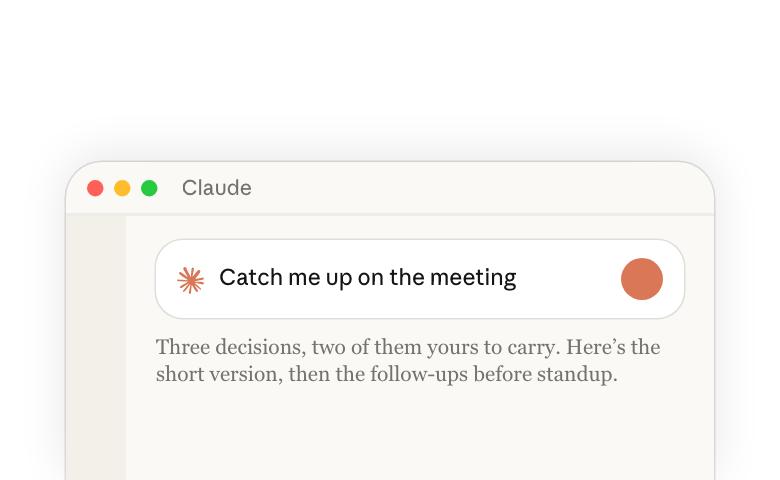
On November 10, 2026, Anthropic announced Claude Meetings. Claude can now join Google Meet calls, take notes, answer questions, and create documents and whiteboards while people are still talking. The feature is rolling out in beta for Team and Enterprise customers.
Anthropic published the details in its official announcement.
For users, this is useful. For founders building products around similar AI capabilities, it raises a question worth taking seriously.
Imagine a SaaS application that joins video calls, produces meeting summaries, and distributes action items afterward. It might have a polished interface, flexible configuration, and paying customers. But when the same basic outcome becomes available inside a product customers already use, what are they still paying the standalone service for?
That does not mean specialized applications will disappear. Some may provide better accuracy for particular use cases, support more meeting platforms, satisfy industry-specific requirements, or handle data in ways a general-purpose assistant cannot.
The problem starts when the product has little to offer beyond a model call wrapped in a convenient interface.
When a feature becomes a commodity
Building a good AI application is not trivial. Even a narrowly focused tool needs infrastructure, an interface, error handling, security, and customer support.
But engineering effort alone does not make a business defensible.
If the main value of an application is a model's ability to transform one kind of information into another, the model provider may eventually offer that transformation directly.
Yesterday, someone uploaded a transcript to a separate summarization service. Today, an assistant prepares notes during the call. Tomorrow, it may act on those notes in the connected systems where the team already works.
A standalone application then needs a reason to exist beyond offering that same AI capability.
This exposure is not limited to meetings. Document generation, data analysis, research, presentations, and other workflows can face a similar problem when the product's main selling point is access to a general-purpose model.
In such cases, the company depends on more than the price and performance of an API. Its positioning also depends on product decisions made by the company providing the model.
The harder part to replace
Now consider a different system.
An organization uses it to manage projects and issues, define workflows, assign permissions, maintain an audit trail, and connect external tools.
AI could help users interact with any of these capabilities. It might find issues, create new ones, update fields, analyze project status, or explain the history of a decision.
But the issues do not live inside the model. Permissions are not defined by a prompt. Workflows do not disappear when the organization changes assistants.
This separation matters.
The model provides another way to interact with the product. The product remains responsible for its data, domain rules, authorization, and execution.
When these responsibilities are separated, improvements in AI platforms can make the SaaS more useful without necessarily replacing it.
There is no permanent defense against competition. A large platform could build its own domain-specific system. Still, reproducing a summarization feature is a different challenge from replacing an organization's accumulated work data, configured processes, integrations, and access controls.
Treat AI as a client, not the system itself
One way to establish this boundary is to avoid designing the entire product around a particular AI model.
Suppose an employee wants an assistant to identify overdue issues and prepare updates. The assistant does not have to be built into the issue tracker. It can be an external client accessing the tracker's authorized operations.
The Model Context Protocol (MCP) provides a standard way for AI applications to connect to external tools and data. The protocol is supported by AI clients including ChatGPT and Claude.
A SaaS product can expose its capabilities through an MCP server. A compatible assistant connects to that server and invokes the operations available to it.
The product does not need a separate implementation of its business rules for every AI model. Users are not necessarily forced to migrate their working data when switching between assistants.
Protocol compatibility does not imply identical behavior, however. Clients can differ in their support for authentication, file transfers, approvals, and particular MCP features. Those differences still require testing.
A service account should not be an administrator
An API or MCP endpoint is not automatically a safe integration.
Consider an automation that creates issues in response to events from another system. It needs access to certain projects and permission to create issues. It does not need company administration rights, billing access, or the ability to manage employee accounts.
A service account gives the automation an identity separate from any employee. It can have its own credentials, restricted permissions, and attributable activity history.
Access can be limited to specific projects and operations. Credentials can be revoked. Changes to the account's roles should affect previously issued access, rather than leaving old permissions valid indefinitely.
Personal AI connections work differently. A user authenticates and grants an application permission to act within their existing authority. A service account should not have to impersonate that person.
This distinction becomes particularly important with AI. A model's ability to formulate an action does not establish its authority to execute it.
The server must enforce permissions, object versions, and business rules. Sensitive operations may require explicit human approval. The audit trail should distinguish the person or application that initiated a change.
An open integration interface is useful only if it preserves the safeguards of the underlying product.
Portability has limits
MCP and service accounts do not make every external service instantly compatible.
Integrations still require supported endpoints, suitable authentication, data mapping, and failure handling. A shared protocol reduces custom integration work, but it cannot eliminate it.
Nor does MCP eliminate dependence on AI providers. Providers can change pricing, access rules, model behavior, and protocol support.
What this architecture can do is reduce the extent to which the product's core functionality depends on one provider.
If an assistant becomes less suitable, the organization's work should continue. People can use the product's regular interface, its API, or another compatible AI client.
This is also part of the approach behind Quevell. Issues, workflows, permissions, and activity history remain in the product, while APIs, service accounts, and MCP provide controlled ways for external software to work with them.
What happens after the next model update?
Before building a business around an AI capability, there is a useful question to ask: if the model provider adds my core feature to its own product tomorrow, why would customers still choose mine?
A compelling answer might involve domain expertise, proprietary data, integrations, reliability, a distinctive security model, or a workflow that is difficult to reproduce. A product does not need to become an enormous platform to have lasting value. A narrow, specialized application can be valuable for reasons a general-purpose assistant cannot easily replicate.
But if there is no convincing answer, adding more AI features may not solve the underlying problem.
Claude Meetings does not prove that specialized meeting products are headed for extinction. In fact, Anthropic's announcement describes plans to work with third-party meeting tools, not merely replace them.
The launch illustrates a more fundamental risk: the company supplying your AI capabilities can also become a source of new competition.
That makes it worth distinguishing what your product can do because of AI from what remains valuable when a particular model is taken out of the equation.